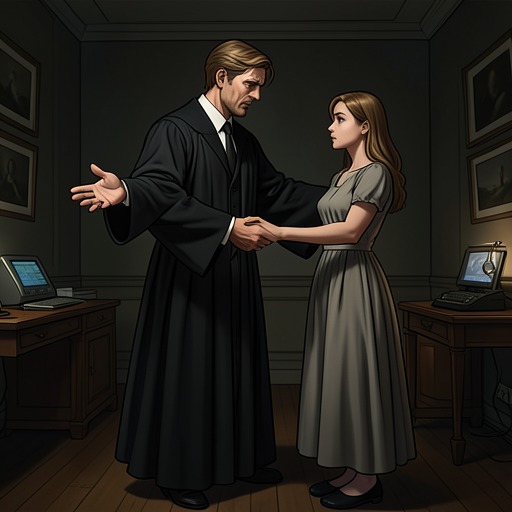
Darius’s Intervention to Protect Clara
His Property (A Dark Vampire High School Bully Romance) (Vampire Boy Swords): Prince of Londinium (Dead Sun: Prince of Londinium (A Dark High School Bully Romance) (Vampire Boy Swords) Book 1)Darius’s Intervention to Protect Clara defines Darius Constantine’s role as both Lord Protector and participant in the struggle over Clara Driscoll. At the Emperor’s Palace ball, he pulls Clara away from Byron Phraeon after Phraeon publicly kisses her cheek and declares that her future is with him. Later, when Prince Octavius attempts to claim Clara through a bite, Darius intervenes again, physically placing himself between them and invoking the rules of the Taleian bonding ritual. The action is protective, immediate, and consequential, yet it remains entangled with the same language of ownership that Clara resists throughout the scene.
Causes and Background
The first intervention follows a public display of coercive courtship. Byron Phraeon keeps Clara in his arms after she asks to be released, kisses her cheek in full view of Darius, Prince Octavius, Carter, and the watching ballroom, and treats the kiss as a mark of precedence. Clara angrily rejects the implication that she belongs to anyone, while Phraeon insists that he will make her his bride and that every challenger, including Darius, will fight for her hand. His conduct turns the dance into a spectacle of competing claims, leaving Clara struggling, distressed, and exposed before the entire ballroom.
Darius responds when Phraeon continues to hold Clara and publicly frames her as someone under his authority. After Phraeon lifts Clara’s gloved hand to his lips and promises to keep watch over her until he can make her his, Clara snatches her hand away. Darius immediately comes to her side, takes her arm, and pulls her behind him. His intervention therefore begins as a bodily separation: Clara is removed from Phraeon’s embrace, but she is also placed under Darius’s physical control. When Darius tells Phraeon to keep away because Clara is under his protection, Clara objects that she can look after herself. The interruption protects her from Phraeon’s immediate advance without resolving the larger conflict over who is entitled to speak for her.
The second intervention arises from the Taleian rules governing a mate claim. Prince Octavius explains that fated mates must fight several duels before they can be joined by blood and establish a psychic bond; only after the challenges may the winner claim Clara with a bite and brand. Despite this stated prerequisite, Octavius kisses Clara forcefully, restrains her when she tries to leave, and moves toward her throat with his incisors exposed. Clara explicitly tells him to let her go and objects that he cannot brand her with his bite. His assertion that Darius is already in her mind transforms the threatened bite into a contest over psychic and bodily access as well as romantic possession.
What Happens
Darius’s decisive rescue occurs when Octavius raises his mouth to bite Clara. Clara is suddenly pulled away, her back striking Darius’s solid body. Darius holds her against him while Octavius opens his mouth, bares his incisors, and hisses. Darius returns the hiss, turning the attempted claim into an openly antagonistic confrontation. Carter arrives in the corridor and sees Darius restraining Clara, Octavius confronting him, and Clara caught between them, but Darius remains the figure who physically stops the bite.
Darius’s protection is not presented only as instinctive force. He also appeals to the formal rules of the ritual, telling Octavius that participation requires adherence to the challenges. The duels must occur before the winner can claim Clara with his bite and brand. When Octavius proposes fighting immediately, Darius refuses the premature contest on procedural grounds: neither he, Octavius, nor the other challengers has yet formed a bond with Clara’s mind. The rules thus become Darius’s weapon. They delay the irreversible act of branding and prevent Octavius from converting a moment of physical advantage into a completed claim.
The scene makes Darius’s intervention physically protective but emotionally forceful. When Clara tries to pull away from Darius, his grip tightens painfully around her arm, and she senses genuine fear for her safety. He does not release her while Octavius threatens to take her. Octavius orders Darius to let her go and declares that Clara belongs to him; Darius answers that the rules will be followed and tells Octavius that his behavior is frightening Clara. The exchange places Clara’s fear at the center of Darius’s stated justification, even as his own restraint limits her immediate freedom of movement.
Participants and Conflict
The intervention sets Darius against two different forms of rival claim. Byron’s claim is theatrical and public: he uses the dance, the kiss, the watching court, and the promise of marriage to display Clara as an object of competition. Darius counters by moving her behind him and naming protection as the governing relationship. Octavius’s claim is more immediate and ritualized: he seeks to complete it through a bite that would draw Clara’s blood and brand her as his. Darius counters with the requirement that challenges precede the bite. In both confrontations, he protects Clara by interrupting another man’s attempt to define her status.
Clara’s own resistance complicates the apparent simplicity of the rescue. She tells Phraeon not to treat her as property, asks both men to let her go, and declares that she can protect herself. Her distress is visible at the ball, where tears, embarrassment, and the attention of the surrounding dancers make private shock into public spectacle. Louise Turner recognizes her distress and comes to help while Darius and Phraeon continue arguing. Later, Clara signals for Carter to remain back because she does not want him injured. These choices show that Clara is not merely a passive object being transferred between protectors: she attempts to withdraw, manages the danger around her, and repeatedly contests the language through which the men describe her.
The intervention is also shaped by Darius’s psychic connection with Clara. He says that their bond came first and is presently the strongest, while acknowledging that Clara may have more than one mate. He can hear, feel, and see her thoughts, including what Phraeon has told her, and warns her not to let Octavius take her with his bite. His knowledge gives him unusual access to Clara’s fear and confusion, but it also makes the boundary between protection and intrusion unstable. Darius understands the danger from inside her mind, yet his response still involves holding her in place rather than simply asking what she wants.
Consequences and Aftermath
Darius’s first intervention breaks Phraeon’s public possession scene. Phraeon is forced to confront Darius directly rather than continue presenting Clara’s future as settled. The interruption also intensifies the courtship rivalry: Phraeon has already promised that the challengers will fight, and Darius’s appearance behind Clara makes the promise immediate. Clara is removed from the dance floor, but the public confrontation leaves her more visibly entangled in the competing claims of Phraeon, Octavius, and Darius.
The second intervention prevents Octavius from completing the bite and brand at that moment. Darius’s appeal to ritual law postpones the claim until the required challenges and psychic-bond conditions have been met. This postponement is a major practical consequence: Clara is not permanently marked by Octavius in the corridor, and the question of who may claim her remains unresolved. At the same time, the intervention does not free her from the system itself. Darius accepts the existence of the ritual, the challengers, and the eventual possibility of a bite; he argues over timing and legality rather than rejecting the structure that makes Clara’s body the prize.
The action also changes the emotional balance among the characters. Octavius becomes openly angry and spoiling for a fight, repeatedly hissing at Darius and insisting that Clara belongs to him. Darius’s calm procedural language contrasts with Octavius’s immediate aggression, but his painfully tight grip reveals that his composure does not mean detachment. Carter’s arrival offers Clara a possible ally outside the direct rivalry, yet she signals him to stay away. The scene ends with danger contained but not resolved: Darius has stopped the bite, the rules have delayed the duel, and Clara remains surrounded by men who interpret protection, desire, and authority through possession.
Narrative Significance
As a rescue action, Darius’s intervention combines the classic structure of protection with a deliberate complication. He is the person who prevents Clara from being kissed into a public claim and bitten into a ritual brand, and he uses both force and institutional knowledge to do so. His role therefore carries real protective efficacy. Nevertheless, the narrative repeatedly places his conduct beside Clara’s objections that she is not property and can care for herself. Protection becomes a contested language rather than an uncomplicated moral category.
The intervention also marks the collision between Clara’s personal crisis and the Taleian political order. She has just learned that her identity and family history were false and that she may be the child of the lost Empress, having been hidden in 1987 centuries before Londinium existed. While she is trying to understand that revelation, the men around her turn her future into a public contest governed by marriage claims, psychic bonds, duels, and blood-marking. Darius’s intervention keeps Octavius from acting outside those rules, but it cannot restore Clara’s former life or remove her from the system that has suddenly claimed her. Its decisive significance lies precisely in that double effect: Darius saves her from an immediate violation while reinforcing the ritual and political framework in which her autonomy remains under pressure.